It started with going to see/hear Raja Shehadeh at the Royal Festival Hall. K had managed to double-book himself, so I went along with Alison, and we had a great evening. He read from his new book, A Rift in Time, which grew out of family research he did into the life of his great-uncle, a political exile from the Ottoman government of Palestine, which is interwoven with his own contemporary story of struggle against the Israeli occupation. Then there was a Q&A led by the director of Profile Books, his publisher, then opened to the floor.
Perhaps unsurprisingly the questions were less about his new book than about his views on the current peace talks (pessimistic) and about the potential for challenging human rights abuses through legal means - something he has spent his whole working life doing, which he seems to feel others are now doing just as successfully, if that's really the word. His recent writings - especially Palestinian Walks - have been about trying to reclaim the land, and his approach to the crisis in Israel/Palestine is long-term and root-and-branch: that basically the settlements not only need to stop being built, but need to be torn up, borders got rid of, and the whole region turned back into something approaching the broader territory encompassed by the Ottoman occupation, shared and lived in equally by all races and religions. He doesn't seem to think that is far-fetched, but I can't see it happening for a very long time.
As Alison said, it was just so refreshing to hear someone so articulate talk in an impassioned but entirely fair and reasonable way about the situation in the Middle East, without giving in to emotion or point-scoring. He signed copies of his book - I got one for Paz and asked him to sign it for her in Arabic. That will be a nice Christmas present, and also a nice exchange for the book she just gave me, the fifth and last in Tariq Ali's Islam Quintet, personally signed by him when she went to hear him talk at the Edinburgh Festival last month.
Then there was a screening of a short film that a father-and-son team have made inspired by Shehadeh's Palestinian Walks - part interview with him, part 'dramatisation' of one of the most memorable scenes of that book, the encounter with a settler during a walk along a stream through the hills around Ramallah where he lives, and their discussion of whose land it is and which of them has the right to walk there. Very poignant.
But what made it so 'London' - if it isn't already great enough that we have access to this kind of event - was the fact that Michael Palin was in the audience, and Stephen Fry was 'performing' in the main hall just underneath us, and when we went down in the musical lift (the RFH choir sings scales at you, upwards or downwards depending on which way the lift is going! A sound installation by artist Martin Creed) there he was signing copies of his new autobiography, with a huge queue snaking round the main foyer of the Festival Hall. Alison and I casually walked past and stared at him for a bit, before heading our separate ways!
----------------------------------------------------------
Then this weekend it is Open House - when hundreds of the city's amazing buildings throw open their doors and let you poke around inside. We were a little more organised than usual this year - at least we managed to book ourselves onto a tour of the London Library, which is somewhere we've always been curious about (not being able to afford the £400-odd fee to become members and find out from the inside!).
They have just finished a renovation and expansion project, and members of the architects firm were there to talk to us about that, which was interesting, but actually I wanted to know more about the Library! Basically it was founded as a gentlemen's club for the intellectually lofty, from what I could make out. We couldn't go into the reading rooms which was a shame, though we peered voyeuristically into them from the corridor. There were hardly any "members" around - the librarian who was taking us round thought perhaps they were all out enjoying Open House. More likely they stayed away from all of us! The stacks were fantastic though - with cast iron grilles allowing you to look all the way up or all the way down through the floors (not good if you have vertigo!) and with book-shelf height carefully worked out to avoid the need for ladders. They have a very individual cataloguing system which is entirely alphabetical within its thematic sections - in the "Science & Misc." part of the stacks (excellent!) 'Fishing' was followed by 'Flagellation' which was followed by 'Flags'!
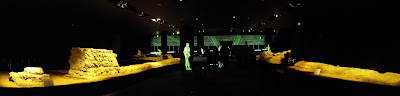
After a restorative coffee, we walked from St James's along to our next port of call, the 'Roman baths' underneath King's College on the Strand. No-one seems to know when these were built, though possibly they're Tudor. From the horrible busy-ness of the Strand, we passed into the deserted square mile of the City of London - it is always so strangely empty at the weekends, when the business people that populate it during the week seem to stay away. We wondered as well if everyone was off looking at the Pope, as London did seem strangely empty yesterday. We were heading for the Guildhall where we spent a few hours - K got excited by the 15th-century Great Hall and crypts, I got excited by the fact there is a Roman amphitheatre underneath it!! Which was only discovered in 1988!!
We also visited the 1:500 scale model of the City of London on display in the 'City Marketing Suite' behind the Guildhall, which shows you what the skyline of central London is going to look like once all the current and projected skyscraper projects are completed - intended-to-be-iconic buildings which already have names ('The Shard', 'The Pinnacle') which are going to completely dominate The Gherkin and ruin the view. But quite fascinating to see it visualised in this way. There was a good interactive and a rather charismatic architect there answering people's questions.
We dipped in and out of quite a lot of Wren churches, which you seem to fall over on every corner in that part of the city, K making use of his recent purchase, the Pevsner for London's City churches. It was revealing of quite how much rebuilding was done immediately after the Second World War, since this part of the city was pretty much destroyed by bombing in the Blitz. We checked historic photos of where we were walking on the Museum of London's iPhone app, Street Museum. They don't have many photos on there yet, but it's a really interesting way of looking at and thinking about where you happen to be standing. We were going to go to the Bank of England, but this was the queue when we got there:
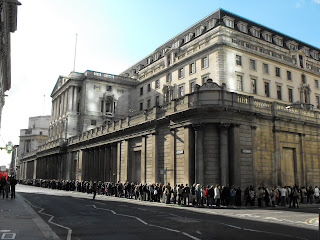
It reminded one of the queues you see on the news sometimes when there are reports in, say, Argentina of the country's economy being on the brink of collapse. K wondered whether they all thought they were going to be given money when they got inside. Perhaps they all knew something we didn't. Still, it's amazing that this many people turn out to look at buildings on Open House!
We got the bus home to Brixton, and because we weren't quite ready to go home, we went to visit Lambeth Town Hall, which was also Open, and got a personal tour by Lib Dem councillor and former mayor, Daphne Marchant, which was an idiosyncratic experience. Though we had come to that meeting of the Planning Committee last year - at which our Residents' Association successfully challenged the Lambeth College development next door - it was interesting to see the Council Chamber and hear a bit more about what goes on behind the scenes.
After that we went to experience the beer garden of our local pub.
They have just finished a renovation and expansion project, and members of the architects firm were there to talk to us about that, which was interesting, but actually I wanted to know more about the Library! Basically it was founded as a gentlemen's club for the intellectually lofty, from what I could make out. We couldn't go into the reading rooms which was a shame, though we peered voyeuristically into them from the corridor. There were hardly any "members" around - the librarian who was taking us round thought perhaps they were all out enjoying Open House. More likely they stayed away from all of us! The stacks were fantastic though - with cast iron grilles allowing you to look all the way up or all the way down through the floors (not good if you have vertigo!) and with book-shelf height carefully worked out to avoid the need for ladders. They have a very individual cataloguing system which is entirely alphabetical within its thematic sections - in the "Science & Misc." part of the stacks (excellent!) 'Fishing' was followed by 'Flagellation' which was followed by 'Flags'!
After a restorative coffee, we walked from St James's along to our next port of call, the 'Roman baths' underneath King's College on the Strand. No-one seems to know when these were built, though possibly they're Tudor. From the horrible busy-ness of the Strand, we passed into the deserted square mile of the City of London - it is always so strangely empty at the weekends, when the business people that populate it during the week seem to stay away. We wondered as well if everyone was off looking at the Pope, as London did seem strangely empty yesterday. We were heading for the Guildhall where we spent a few hours - K got excited by the 15th-century Great Hall and crypts, I got excited by the fact there is a Roman amphitheatre underneath it!! Which was only discovered in 1988!!

We also visited the 1:500 scale model of the City of London on display in the 'City Marketing Suite' behind the Guildhall, which shows you what the skyline of central London is going to look like once all the current and projected skyscraper projects are completed - intended-to-be-iconic buildings which already have names ('The Shard', 'The Pinnacle') which are going to completely dominate The Gherkin and ruin the view. But quite fascinating to see it visualised in this way. There was a good interactive and a rather charismatic architect there answering people's questions.
We dipped in and out of quite a lot of Wren churches, which you seem to fall over on every corner in that part of the city, K making use of his recent purchase, the Pevsner for London's City churches. It was revealing of quite how much rebuilding was done immediately after the Second World War, since this part of the city was pretty much destroyed by bombing in the Blitz. We checked historic photos of where we were walking on the Museum of London's iPhone app, Street Museum. They don't have many photos on there yet, but it's a really interesting way of looking at and thinking about where you happen to be standing. We were going to go to the Bank of England, but this was the queue when we got there:

It reminded one of the queues you see on the news sometimes when there are reports in, say, Argentina of the country's economy being on the brink of collapse. K wondered whether they all thought they were going to be given money when they got inside. Perhaps they all knew something we didn't. Still, it's amazing that this many people turn out to look at buildings on Open House!
We got the bus home to Brixton, and because we weren't quite ready to go home, we went to visit Lambeth Town Hall, which was also Open, and got a personal tour by Lib Dem councillor and former mayor, Daphne Marchant, which was an idiosyncratic experience. Though we had come to that meeting of the Planning Committee last year - at which our Residents' Association successfully challenged the Lambeth College development next door - it was interesting to see the Council Chamber and hear a bit more about what goes on behind the scenes.
After that we went to experience the beer garden of our local pub.


