Sunday, 15 August 2010

The Incident of the Rhubarb Tarte Tatin

It was Friday the 13th, and I quipped to Andrew by email, "I hope I don't burn the dinner!" Hmmm. I had chosen a fancy dessert recipe from Olive to wow our dinner guests, and also to use up the last batch of rhubarb from K's parents' garden. First problem - I haven't cooked with rhubarb much before, and had never made a tarte tatin, and found upon reading the recipe closely that this was supposed to be done in blini pans or in a Yorkshire pudding tray with four indents, neither of which I had. So a single tarte tatin in a cake tin it was going to be. Then came the issue of making the caramel base. I discovered the hard way (er, literally) that when the recipe says butter and granulated sugar, one should not use caster sugar to make caramel.

After two attempts (the first with golden caster sugar, the second with normal refined caster sugar, just in case its goldenness had been the problem), K was dispatched to the local corner shop to procure granulated sugar, and hurrah! all proceeded satisfactorily with caramel production. I made a nice arrangement of the rhubarb bits on top of this, and I must say the tarte tatin did look beautiful when it was turned out. I don't have a photo unfortunately. Andrew was presented with the first slice and we all waited for the verdict - poor man, having been put on the spot, he did a valiant job of keeping a straight face. I tried a bite of mine - decidedly sour!! What happened to all that sugar in the caramel??? Plus the recipe suggestion of serving this with mascarpone was not a good choice.

With lashings of caster sugar, the dessert was eaten, but lesson learned - always test a new dessert recipe before serving it to one's dinner guests!! Alas, I feel this episode might go down in personal legend - "remember when you did that rhubarb tarte tatin for Alison and Andrew....?"

----------------------------------------------------------

The nice thing, however, was that we had a dinner party at all. It has been far too long since we had people over for supper, and this is one of the very nice outcomes of the time I have off work at the moment. Five whole weeks! I had so much annual leave to use up, having taken almost no holiday over the busy last few years, that I decided to take a big batch of time off in the middle of the summer - when it is usually quiet anyway - and spend it in the library, finally starting to focus on how to turn my PhD thesis into a book... I get two different reactions to this:

1) "Don't work too hard / Make sure you actually give yourself some time off!"
2) "Five weeks in the library! What bliss!"

I fall into the latter category myself. Two weeks in, and I am feeling immensely relaxed! I have said before that I don't really know how to relax like normal people - I actually really enjoy going to the library, and it is wonderful just to have the time to read things. I made a list of books and articles that have been published since I submitted my thesis in 2002 - not too long fortunately - and have been working my way through that, but also reading the odd other article, which I'm interested in but isn't directly relevant... Plus - I have space in my brain! And time to get round to things I have been meaning to do for months! Like write emails, send people photos or references I said I would send them, and just see people and be sociable!

The British Library is a pretty sociable place, as I have noted before, and I have been meeting friends for lunch and coffee and a post-library drink. Now Juliette has joined me in Rare Books, on her own PhD sabbatical, and we're getting into a habit of taking our packed lunches outside at 1, to sit in the sun for half an hour or so, and debrief... K will be off work too soon, so the 3 of us will be chilling out together...

And two weeks in, I have nearly a complete first draft of a book proposal! Reading the thesis again after 8 years was an interesting experience, and I was gratified to discover that it wasn't too awful, and that mostly I still agreed with myself... It's a bit dry and in some places overly defensive, but that's what makes a PhD different from a book, and that's what I have got to work out how to tackle. I've even had some positive feedback from the professor who supervised me for the beginning of the process, but didn't see it through because he went off to the States to be a hot-shot museum director - amazing to have some actual feedback as the viva was such a let-down... But water under the bridge an' all.

So - the next dinner party is planned for just over a week's time, and I'm already plotting the menu. I'm starting with the dessert first this time...!

----------------------------------------------------------

And finally...

Signpost, Chenies © KR

Our calendar picture for this month. A very English country road sign, but for K one which conjures up the places of his childhood. Chenies was where his grandparents lived, both now passed away. It was exactly this time last year that we were in Hereford for the 3 Choirs Festival, unknowingly spending our last days with his grandfather Robert... Perhaps a little sombre for the kitchen calendar, but it prompts some happy memories.

Sunday, 8 August 2010

Henry Moore and the Jets

K ponders the Harrier, one of the two fighter planes in this year's Duveens Commission

That title might suggest this posting might actually be about Henry Moore, whereas the only link is Tate Britain - and I just couldn't resist the rock'n'roll title, Henry Moore being possibly the person I least associate with rock'n'roll....!

James commissioned us to go along to Tate and assess this year's Duveens Commission, Harrier and Jaguar, by artist Fiona Banner - so we thought we would combine it with going to see the Henry Moore exhibition before it closed. Nothing much to say about that - apart from, as K observed, grouping a whole load of Henry Moores together in an enclosed space does nothing for one's appreciation of his wonderfully abstract creations. Each one needs to be contemplated on its own terms, the way you do when you stumble across them as public sculpture, but in an exhibition environment, after a while you get fatigued by the requirement to give each one an equal share of your intellectual capacity...

The most memorable thing for me was the room dedicated to the series of drawings he made during the Second World War, especially of coal miners in Yorkshire, and of sheltering women and children in the tunnels and platforms of the London Underground. Inevitably the hundreds of sleeping figures take on the ghostly feel of Moore's signature 'recumbent forms'...

But to the Jets. As an aviation journalist who appreciates art and museums, James was keen to know what we - as two curators - thought of the current installation of two fighter planes in the neoclassical surrounds of the Tate's Duveen gallery, the implication being they had become art objects rather than objects of destruction. I am going to attempt to get my thoughts on all this in some sense of order for him here.

The first thing is that it is completely awe-inspiring. You see the jets first as beautifully-designed objects, and then you remember that they are designed that way in order to be more effective killing machines. This creates a sense of tension and awkwardness inside you which is the essence of the artist's intention, I think. This is especially so with the Jaguar, cleverly shown upside down, so you find yourself admiring the sleek engineering of its under-carriage, and then discover you're face-to-face with its gun ports.


I don't know if I'm using the correct terminology to describe any of these bits of the plane, and in fact my utter ignorance of this type of object was also part of what disconcerted me about their display. I didn't know if what I was looking at had been 'interpreted' by the artist in any way (and the text on the wall panel didn't clarify that for me, even when I finally read it) - I didn't know if the suggestion of feathers painted on the wings, nose and tail of the Harrier Hawk were put there by the artist or whether they were part of the original design of the planes; I didn't know if a Jaguar normally looked that shiny. Having watched an interesting short film about it on the Tate website (what a joy, may I say, to listen to an artist being so articulate about their work), I now know that the Jaguar was stripped back and polished for the exhibition, but there was something unsettling about my ignorance at the time I was looking at them.


I wonder if this is a female response? Most of the men visiting the galleries seemed inexorably drawn to the planes and seemed to want to 'explain' them to the women they were with - I suppose a symptom of making Airfix models as boys, and all wanting to grow up to be fighter pilots... One man - and this was extremely perturbing - posed for several photographs standing astride the long nozzle projecting from the front of the Jaguar, so blatantly phallic. These photos were being taken by a female friend or partner who seemed to think it all very amusing, but you felt you were intruding on something too intimate - not to say vulgar and rather pathetic - to be out in the open like that.

I felt the planes were poised as if they had just come to land - crash landed in the case of the upside-down Jaguar, though obviously there was no damage to it. The Harrier was just hovering with its nose a few inches off the ground, as if it had just plunged through the roof and caught in the branches of a tree or something - though the curator in me wanted to know more about the superstructure supporting it in that position... There was something slightly sinister about the 'greyed-out' appearance of both cockpits - I felt if I looked too closely I'd see someone in there, a dead pilot perhaps.

I suppose that was the tension surfacing again, the fact that you are so strongly aware of these objects' original function - these are both actual decommissioned planes which have seen action in recent international conflicts: the Jaguar was in Desert Storm. I felt happier - if that's the word - comforted even, that this meant they were authentic - that we were not just looking at them as gratuitous symbols of conflict, they had actually been there. Though, again, the tension, the unsettling awkwardness...

The polished, seemingly silver-plated, precious-metal surface of the Jaguar now reflects the architecture of the galleries enclosing them, and more than one person was taking photographs of this artistic reflection. This is deliberately part of Fiona Banner's effect - the Tate built with the funds from slavery, in the neoclassical style that was the symbol of empire at the time it was built, now housing these modern symbols and tools of empire. The display works because of its environment, in a more successful way than I have seen for a long time - seeing the planes in that space generates thoughts and feelings which I can't imagine thinking if I saw the planes in a airplane hangar or in an aviation museum. Perhaps I would, but there is something about the creative intent behind stripping and decorating them in this way, the whole idea that they are now art, that makes you look at them in a completely different way. Well, it provokes thought, and that has to be a good thing in an art installation.

So thanks James for our own commission! My head was so deeply buried in the ground during the last few months that I didn't even know about it, so I'm grateful for the excuse it gave me to start to reopen my eyes to the outside world.

Sunday, 18 July 2010

The constant composter

Wool drying, Lewis & Harris, Outer Hebrides © KR

This month's calendar picture - the only one in colour, just because of the beautiful contrast of colours it shows, which is so typically Scottish, or so typical of what we now associate with the Outer Hebrides. This was taken outside the home and workshop of Marion Campbell, the tweed weaver we went to visit on Harris last summer. There is something amazing - but I suppose not all that surprising - about the way the earthy colours of the wool echo the colours of the hills on the horizon.

I haven't blogged about this year's Hebridean holiday - there are just not enough hours in a day to get down here all the things I would like to write about, all the thoughts that pass fleetingly through my brain... I have finally got round to loading up some images on Flickr, a selection of about 50 out of the 400 or so photographs I took, mainly of amazing landscapes, and K and my sister pulling silly faces... The home-movie, The Langass Witch Project, is worth a watch though! (We climbed Beinn Langass, and I was trying to figure out how to photograph the amazing views from the top, and had the brainwave that a panoramic movie would capture the scene much better than a series of stills - but my endeavour was rudely interrupted...)

This year we were on North Uist, where my sister has been living since November, which is the second-most northerly of a string of five islands linked by causeways - though the word 'islands' is in some ways a misnoma, since they are potted with so many lochs and bodies of water that it doesn't feel much like a landmass sometimes. As with Lewis and Harris last year, the landscape is almost achingly beautiful, with such contrasts from one view to the next - ragged mountains on the horizon in one direction, miles-long sandy beaches with transparent turquoise seas in another, undulating treeless peaty moorland all around you, suddenly interrupted by the bright colours and heavy scent of the machair, meadows which grow behind the sea and before the peat, which were covered with wildflowers and teeming with wildlife, full of species of flora and fauna I had never seen in my life before!


We spent most of the time outside - a wonderful change from being cooped up in libraries or offices or galleries. K bought a small book about the archaeology of the Uists, which had a helpful gazetteer in the back, and we used it as the starting point for long walks in different parts of the islands. The joke became that the archaeology consisted of piles of stones in different configurations, be it chambered cairn, or Iron Age wheelhouse (the oldest 'buildings' in Europe apparently!), or medieval chapel... In fact it didn't really matter, it was the walk there that counted. One feature we thought particularly beautiful was the dun, or artificial island built out in the middle of a loch, linked to the land by an ancient causeway. The dun usually had a structure built on it, a cairn or a burial mound or domestic structure. You'd see them all over as we were driving around.


This time round we stayed in a B&B, run by a rather eccentric Dutch artist - a wonderful place in a beautiful setting, but he had quite strict breakfast times, which sometimes involved having to talk to strangers (other people who were staying there) without having yet imbibed sufficient quantities of coffee to have properly woken up! So we didn't get as much sleep as I would have liked and I did very little reading (only got through one book), and it confirmed us in the view that self-catering is definitely the way to go - memories of that gorgeous little cottage on Harris last year... But the infrastructure for that kind of tourism doesn't exist on the Uists yet, somewhat surprisingly. I was only partly joking every time I saw a run-down blackhouse for sale, about buying it and doing it up and renting it out... (especially since our house-buying plans in London are rather on the backburner these days)

So many stories and happy memories - slightly embittered by the personal difficulties that my sister has been having, and her indecision about what to do with her life. It seems she might be moving to Edinburgh now, where she was at university - I won't mind! I love Edinburgh, and it will be great to have the excuse to visit it more, plus it will be easier to get to see her, since getting to the Hebrides is not all that easy (one of its charms, of course) and can be rather expensive. We might try the Inner Hebrides next year, especially since there is a possibility that my parents might be about to move there... (Hmmm, don't think I should be taking it personally that my immediate family are all moving away!)

----------------------------------------------------------

I've done a neighbourly turn this afternoon, which I am feeling rather self-satisfied about. I have donated a good load of the compost we have been making for over a year now to the friend of a friend, who lives two streets away and has an allotment. It's all very well composting our food waste, but the bin was getting full, and though it goes down as the waste rots, ultimately it seemed a bit pointless if we weren't going to do anything with it. I tried offering it to the Brockwell Park Community Greenhouses, who were very nice about it but understandably have to observe DEFRA health and safety guidelines about the compost they use being made on-site; then a colleague of K's said she was sure her friend Honor would be interested.

I commandeered an abandoned barrow (I quickly realised why it was abandoned - it has a flat tyre), and borrowed some trowels from Lisa, the lady who technically owns the compost bin, though about 4 or 5 flats have been composting in it for a good long while now - then started excavating. It's quite good stuff! Amazing to see what all our food waste turns into! Lots of worms, which is apparently a good sign! Honor happily carried away three heavy bags worth, and will be back in the autumn for more! She gave us a lovely looking lettuce and two amazing courgettes in exchange - and it just seems so good that it will actually be going to some use. And it's created lots of space for more good composting! So now I can carry on composting with a clear conscience, and it has impressed K, I think, who was always a bit dubious about our compost. So good turns all round!

Monday, 12 July 2010

¡Campeones del Mundo!

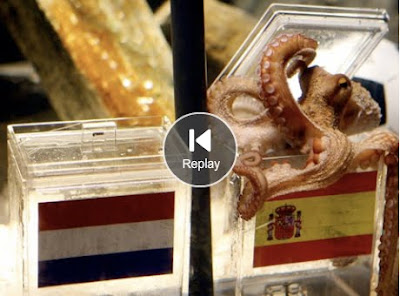
'Pulpo Paul' - as they call him in Spain - predicts the Spanish win (100% success rate for this psychic octopus! I just want to know who on earth first thought of asking an octopus to predict football results!?)

and about time too!! Spain have been not-quite-achieving for so long but they are worthy World Cup winners - though, being a quarter Dutch, it was ever such a slight dilemma knowing who to support...

Actually it was never in doubt. I first started supporting Spanish fútbol when I was living in Madrid for a year, researching for my PhD, and Real Madrid won the Champions League - can you believe that is 10 years ago now, in 2000?? (Can you also believe there is actually a Wiki page on that particular match!) They returned to Madrid covered in glory, and there were processions and celebrations in the street - I just got caught up in the joy of it all.

So I can well imagine the logjams that wild partying in the streets of Madrid has apparently caused as Spaniards celebrate their victory! A picture on El País shows Gran Vía absolutely crammed with people in red and gold shirts! The outbreak of support for the national team - "La Roja" - across Spain has apparently also done much to heal separatist rifts: an interesting article on the Guardian about that here.

Great pictures on El País tonight of the team returning home and being received by the royal family at the palace - everyone just looks so happy and relaxed! Can you imagine our queen and prince consort looking so happy when faced with a squad of footballers?? There was a great moment, just after Iniesta scored his historic goal last night, when the TV camera caught la Reina Sofia whooping for joy with her arms in the air! I had hoped to find it on YouTube, but it doesn't seem to be up there - perhaps it is not an unusual occurrence! But if it had been England winning the World Cup (er, please excuse a moment of fantasy) can you imagine old Lilibet even twitching a smile?!

¡Enhorabuena España!

Sunday, 11 July 2010

My book is in the shops!


and the Ceramics Study Galleries are open - the two major projects I have given all my time to over the last several years are successfully complete, and I am becoming increasingly aware of an unfamiliar feeling of aimlessness in my extra-curricular time. It's not that I don't have research or writing projects I could be doing, I just don't want to be doing them - or rather, I feel that I have earnt some time off from them, just that I don't really know what it is that normal people do with their free time. I suppose part of the problem is that K has two article deadlines to meet, so he is writing writing writing, so I can't make any plans for us to go off and do things together at the weekend. And I quite enjoy luxuriating in the pure fact of having nothing to do.

But I have read enough of the LRB and my current book, The Rings of Saturn (which I have to say I am not enjoying nearly as much as I ought to be - especially since it is one of K's most beloved books), and have caught up with the Guardian profile of Simon Mawer and review of his recently-Booker-nominated The Glass Room - the book I read on holiday, which was such a wonderfully evocative portrait of a Modernist building that when I eventually brought myself to look at photographs of the Tugendhat House in Brno, Czech Republic, upon which it based, I felt I had already seen it... I have caught up with a good few long-overdue emails, and we have even started to arrange to see people again!

I feel like I am re-emerging from a long period of hibernation, but am out of practice where basic social pastimes are concerned - perhaps because our habit over the last years has been to do our research in all the spare hours we can carve out from the day. I made a conscious decision early on in my working life to maintain an active academic strand alongside my job - of course those things should cross over more than they do - but I feel I have now got to the stage, especially now that I have been promoted, where I do not have anything to prove any more, and I am grateful for that. But it is difficult to suddenly learn to relax when you've never really been sure of how to do it! I have done quite a lot of cooking - hours in the kitchen last night producing Ottolenghi's turkey and sweetcorn meatballs, and as always with meatballs I am not sure that the end result really justified the hours of faff; I have even done all the washing up (things must be bad!).

This lull is also actually only a brief window before embarking on the next book project - in August, I am using up 5 weeks of my accumulated leave (having not really taken any holidays over the last few years) to start focusing on how to turn my thesis into a book. I haven't looked at it for 8 years, and don't really want to think about it at all before 2 August - when I plan to pitch my metaphorical tent in the British Library for the duration (people who don't realise I am not going on a month's holiday say, "I hope you're going somewhere nice"!) - so I am trying to get my ducks in a row (scans from Spanish colleagues of articles that have come out in the last 8 years, a sense from EUP - where I plan to propose it - of what I should have achieved by the end of August) without really engaging my brain, since I want to come to it absolutely fresh when I finally sit down and re-read it. I am hoping that the intervening years and publishing projects will make it immediately obvious to me what it needs, but I also don't want to do too much rewriting, mainly restructuring and reducing. But who knows what will possess me.

In the meantime, we're having a glorious summer and I really should be outside. Thank goodness we have the Lambeth Country Show next weekend!

Wednesday, 9 June 2010

Two pots

In honour of our new Ceramics Study Galleries - the break-neck project I have been working on full-time for the last 9 months, which had their gala opening last night, and which open to the public tomorrow - I wanted to blog about two pots I have acquired recently.


This vase was designed by Keith Murray for Wedgwood in the 1930s. Murray was trained as an architect and brought an architectural eye to his ceramic designs. My colleague, the curator of modern and contemporary ceramics, tells me that he thinks Murray was one of the best Modernist designers for pottery, and I love its simple yet very structural elegance. This design was glazed in this 'Moonstone' white, in an olive green, and a metallic grey, and other versions of it were made with more and thinner ribs, and in different functional forms including a gorgeous pair of bookends which I would love to have! You can find more info here on the Museum's example of this vase - with a rather better photograph.

This is the only thing I chose to keep from among K's grandparents' possessions. He made a long list, including the two bookcases which arrived in time for lunch on Easter Sunday, probably made in the 1930s as well, so the vase looks right at home on top of them, in the corner of a 1930s flat. I was invited to keep whatever I liked, but the only thing that had always rather caught my eye was this vase - tucked away on top of the kitchen cabinets and wonderfully unfussy in the context of Betty and Robert's rather more decorative taste... Apparently when they had valuers in to assess their collection, it was the only thing that they said was really worth anything. But it was already spoken for.


And facing it, a rather different object. This is a late 19th-century storage jar which I bought in Tunisia recently. Again it is very close to one we have in the collection, which was acquired in 1894, which therefore helps me to date this one.

I was in Mahdia, and finally had a bit of free time to wander around in the souk of that small and special town. Two of us went to buy a present for the lady who had done most of the organising of the Summer School (which I will write about soon!) and we had been directed by some colleagues to a street that was slightly off the beaten tourist track, where there were looms and textile shops. We bought her a lovely silk scarf (and one each for ourselves, ahem) then before we knew it had been lured into a neighbouring shop. It was all shiny touristy kitsch in which I had no interest at all, and we disengaged ourselves pretty quickly, but the kindly gentleman proprietor was not going to give up that easily and asked if he could show us one last thing in the shop opposite. As we stepped in, I could see there were some genuine antiques in here and said to myself "Aaah, this is the real stuff" - which he heard so of course we started talking about the fact that I worked in a museum in London which had some Tunisian ceramics in its collection, and which I had been looking at recently for the Study Galleries.

I had sort of promised K that I wouldn't buy any pots on this trip (since I have rather a habit of doing so and we are running out of space in our small flat...) but I couldn't resist when I saw the collection of 19th-century wares he had underneath a table loaded with jewellery - forgive the Orientalist simile, but was a true Aladdin's cave! My only consideration was size and which one I could feasibly fit into my suitcase! I had run out of dinars so paid him in sterling - £40 which I thought was a complete bargain!!

The shopowner - Mr Ben Rhouma - said he acquired the pots from people who had them in their homes, inherited from forebears, and knew that the occasional tourist liked to buy them, so sold them to him for a bit of ready money. He does nothing at all to them, so it was a bit cobwebby and still is a bit dusty, but since learning how to clean pots for our Ceramics Project I will be applying my cotton swab any time now. There is a broken section at the rim, but the piece was inside, and one of my conservator colleagues has loaned me some paraloid and instructions for how to reattach it in a conservation-approved manner.

Two pots, completely different aesthetics, but I love them both, and the memories they conjure.

----------------------------------------------------------

And thank goodness the project has finally come to a triumphant close! The galleries look amazing - "overwhelming" and "awe-inspiring" were some of the phrases that people mentioned to me last night. They are visible storage galleries with massed groupings of objects organised geographically and chronologically, but the sheer quantity and scale is so impressive, it takes your breath away. But now it is time for a holiday. On Friday morning at the crack of dawn we leave for North Uist to visit my sister, chill out for a week, visit seal colonies, eat smoked salmon, and read the 3 for 2 book selection I acquired in Waterstone's in Hereford last weekend (having finally come to the end of the 3000-and-some-pages of the Baroque Cycle - magnificent, but it has taken me 6 months!!). So I'll check in again in a couple of weeks. Over and out.

Sunday, 6 June 2010

Cast ne'er a clout...

... till may be out. So goes the old proverb, warning the optimistic against shedding too many clothes before - either the month of May, or before the hawthorn blossom appears, called 'may' because that is the month it traditionally blooms. And boy was it in bloom in Herefordshire last weekend!!


All those bushes with the glowing white blossoms. It was K's birthday on Friday and bank holiday on the Monday, so we took a long weekend and went to visit his parents. We took an early Thursday evening train after work, which also meant I could get away from it all after my promotion interview which was that morning (on which more below) - and as always when we go to Hereford, you get out in to countryside quite quickly, and as the train pulls further from London and gradually empties and the landscape through the window becomes more and more picturesque, you feel the weight gradually lifting from your shoulders...

And now that they are both retired, K's parents are making the most of exploring the Herefordshire countryside, which is something we have not done much with them at all - so on Friday evening we drove to a country pub for K's birthday dinner, taking in a gorgeous early evening walk along the ridge at Much Marcle (I also love the placenames in that part of the country...) with its panoramic views on both sides; and on Sunday we took a picnic and went to Wigmore, in the far north-west of the county, the region known as the Welsh Marches because it is right on the border with Wales and historically was a major defensive zone for the English. My marauding ancestors were on the far side of that border! In fact, not too far and not too marauding, and not too ancestral - my father grew up in Presteigne!

But this is where we were last Sunday -


- Wigmore Castle, a 12th-century ruined castle, managed by English Heritage. When they opened it to the public in the 1980s, the fact that they had preserved the castle's ruinous state was highly controversial - I guess people thought it should have been rebuilt so you could see and experience how the castle would originally have looked. But you can see and experience that in many other places, and over the centuries, this site had become a major ecological site for wildlife and wildflowers, so English Heritage were quite ahead of their time in treating this as a conservation area - they stabilised and strengthened the walls of course, and obviously did a lot of work, in very subtle ways. It was an extremely atmospheric and beautiful place. These were the views from our picnic spot - towards England...


towards Wales...


If you look at the large version of this picture, you can even see the spire of the church at the wonderfully-named Leintwardine.

Magnificent rolling hills. Sometimes you just can't beat the British countryside for beauty.

----------------------------------------------------------

And I got that promotion. I heard on Friday morning. I had been stressing about it and trying not to since the interview, which really takes it out of you, I can tell you. So I now feel enormously relieved, and proud and happy, and rather more relaxed than I have done in a while. Two colleagues from my department also went through, and we went out for impromptu celebratory cocktails on Friday evening - then K and I went out for a truly wonderful dinner at Upstairs - another one of Brixton's gastronomic delights. This gorgeous little place opened a few years ago, and we gradually heard about it via word-of-mouth because it doesn't advertise itself. You would never know it was there if you didn't know it was there - if you know what I mean! It's a converted flat above a cafe, with a bar on one floor, and the 'restaurant' at the top, all very tastefully-decorated and the food beautifully-presented and delicious. The dining area only seats about 25 people at the tables so it's an intimate place, and we started eating late so sat there gradually more illuminated by candlelight as the sun went down... Lovely. Even better for just having a 10-minute walk to get home.